Cart
Your shopping cart is empty!
It's never too late to make things right :)

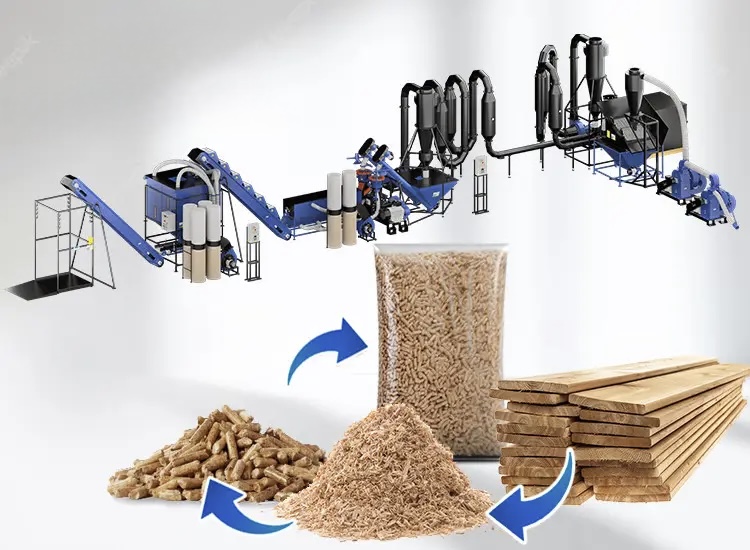
The first stage involves reducing the raw material to approximately 25 × 25 × 2 mm. This size allows the wood to be dried efficiently and uniformly.
Before pressing, the biomass should have a moisture content of 8–12%. Therefore, the material must undergo a drying process. Two main types of drying equipment are commonly used:
Drum dryers – suitable for processing large volumes of biomass in industrial production facilities.
Belt dryers – provide controlled, uniform and gentle drying of the material.
After drying, the biomass passes through a magnetic separator and a stone trap equipped with a screen. These devices remove metal particles and mineral contaminants. The material is then fed into a hammer mill, where it is ground to the particle size required for pellet production. Conditioning and Moisture Regulation
Proper moisture content is essential for effective fibre binding during the pressing process. If the raw material is too dry, particularly below 8% moisture, pellet formation may become difficult. For this reason, the biomass is moistened when necessary before pressing.
Conditioning takes place in a mixing chamber. Depending on the wood species and the condition of the raw material, water or steam can be used. Water is commonly suitable for softer wood species, while steam can be beneficial for harder woods or raw materials that have been stored for a long time.
This process improves pressing conditions and helps achieve consistent pellet quality.
After preparation and conditioning, the biomass is fed into a pellet mill. Depending on the production system, the equipment may use either a flat die or a ring die.
Under high pressure, the material is forced through the round openings in the die. The resulting pellet strands are then cut to the required length.
Wood naturally contains lignin and cellulose. Under the influence of pressure and heat, lignin softens and helps bind the wood fibres together. As a result, wood pellets can generally be produced without additional chemical binders.
Small quantities of suitable additives, such as starch or flour, may be used to improve pressability and pellet durability. Their proportion should not exceed 0.5%, unless the specific formulation and applicable quality requirements provide otherwise.
Freshly pressed wood pellets typically reach temperatures of 70–90°C. At this stage, they are relatively soft and vulnerable to mechanical damage.
The pellets are therefore transferred to a pellet cooler, where they are cooled using ambient air. During cooling, their structure stabilises, their mechanical strength increases, and they become more suitable for transportation and storage.
In the final production stage, the cooled pellets are screened to remove fines, wood dust and broken pellets. Where their quality permits, these materials can be returned to the production process for reprocessing.
The finished pellets are then packed into bags, big bags or loaded loose into suitable transport vehicles, depending on the distribution method. To maintain their quality during storage, pellets must be protected from moisture. A dry storage area and suitable packaging help preserve the fuel's properties over an extended period.
| Production parameter |
| |
| Initial wood chip size |
| |
| 8–12% | |
| Drying equipment |
| |
| Pellet mill type |
| |
| Temperature after pressing |
| |
| Possible additives |
| |
| Storage conditions |
|
Optimal operating parameters depend on the wood species, equipment configuration and required product quality.

An efficient wood pellet production line combines size reduction, drying, cleaning, fine grinding, conditioning, pressing and cooling into a coordinated process. Selecting the right machinery and maintaining consistent raw material quality are essential for reliable operation, efficient energy consumption and the production of high-quality wood pellets.
Leave your contact details and we will get back to you within 15 minutes.

